 TEQcloud
· Quinten de Haard · Projects · 4 min read
iTEQ is now in public beta
The EU passed Chat Control. So we built our own chat platform — end-to-end encrypted, self-hosted, and now open source.
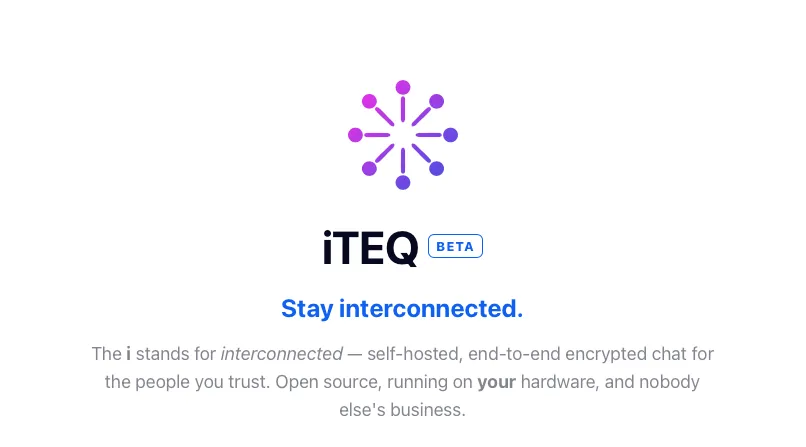
iTEQ: your chats, your hardware
On 9 July 2026 the EU revived “Chat Control”. A majority of MEPs actually voted to reject it, 314 against 276, but overturning a Council position requires an absolute majority of 361, so it passed anyway. To be precise: this version covers voluntary scanning, and end-to-end encrypted services like Signal and iMessage are exempt for now. The mandatory version is still on the table, with negotiations resuming in September 2026.
Signal and iMessage sit at the trustworthy end of the market. Most other messengers are, structurally, a weekend hobby: small side projects of companies whose core business is advertising and AI training at planetary scale. The encryption on the wire can be perfectly real while every incentive around it points the other way. That is why a service like Proton costs money. Paying with euros instead of data is the only business model that makes the privacy promise credible.
So I did what a homelabber does when the rules keep shifting: I stopped renting and started running. Meet iTEQ (the i stands for interconnected).
Why this matters
Two reasons, beyond the headlines.
Modesty is a hard requirement, not a preference. For roughly two billion Muslims, and many people of other faiths or none, some photos are strictly for family and close friends. A photo of a woman without her hijab, for example, does not belong on a server owned by strangers, no matter what the privacy policy promises. Big tech has simply never designed for this. I know that from home, not from a market study.
Family photos are not a dataset. The pictures you send to the grandparents should not be scanned, classified, or trained on. Terms of service change. What a model has ingested never comes back out. Your children are not AI training data.
iTEQ exists to self-host the data that is precious to you, with privacy as the main objective. Not as a policy, as physics.
What it is
A chat platform that runs on your own containerized infrastructure, Kubernetes or plain docker compose, and works in any browser on iOS, Android, PC and Mac (add it to your home screen and it behaves like an app).
- End-to-end encrypted, in the browser. Your PIN derives your keys; messages, files and even chat names are AES-256 ciphertext before they leave your device. The server, mine included, only ever relays and stores encrypted blobs, usernames you made up, timestamps and sizes.
- Nothing is kept. Chat content is deleted after 7 days, max. Per chat you choose RAM storage (gone on a restart, by design) or SSD storage (survives reboots, still 7 days). Files up to multiple gigabytes, with an “uploaded” indicator so you know when they’re safe.
- Closed by design. Every new account waits until the operator personally approves it. No search, no directory. Read receipts exist but are yours to switch off, both ways.
Honesty first, as always: this is trust, not a promise — and the security policy spells out precisely where that trust sits, including the things end-to-end encryption doesn’t protect you from when you don’t own the server. That transparency is the product.
Get it
iTEQ is now open source (Apache-2.0, free to use, the TEQcloud credit stays):
- Source code & docs: github.com/TEQ-cloud/iteq
- Helm chart: artifacthub.io/packages/helm/iteq/iteq
- Images:
ghcr.io/teq-cloud/iteq-api+iteq-web(amd64 & arm64)
Three tutorial videos are coming at full release, covering docker compose, Helm, and Argo CD, so you can start self-hosting your own iTEQ instance. And if running the infrastructure yourself turns out to be too much: managing Kubernetes infrastructure is basically what I do. TEQcloud keeps your cluster healthy while the data stays on your hardware and the keys stay with you. Get in touch.
The full roadmap and everything else lives at i.teqcloud.net.